About this template
Help visitors understand your conservation approach, the kinds of works you care for, and how to begin an enquiry. The design introduces a careful, minimally invasive philosophy and gives clear space to explain services for paintings, works on paper, and selected objects and frames.
A considered layout pairs expressive artwork-inspired visuals with practical details about your process, from listening and examination to treatment and future care. Visitors can review the approach and services, then start a conversation about a work they hope to preserve.
Who it’s for
Art conservators, restoration studios, and independent practitioners working with paintings, works on paper, frames, or selected decorative objects.
What’s included
The page guides prospective clients from your conservation philosophy to relevant services and an enquiry invitation. Its restrained typography, artwork-led visuals, and numbered process make both your values and practical next steps easy to follow.
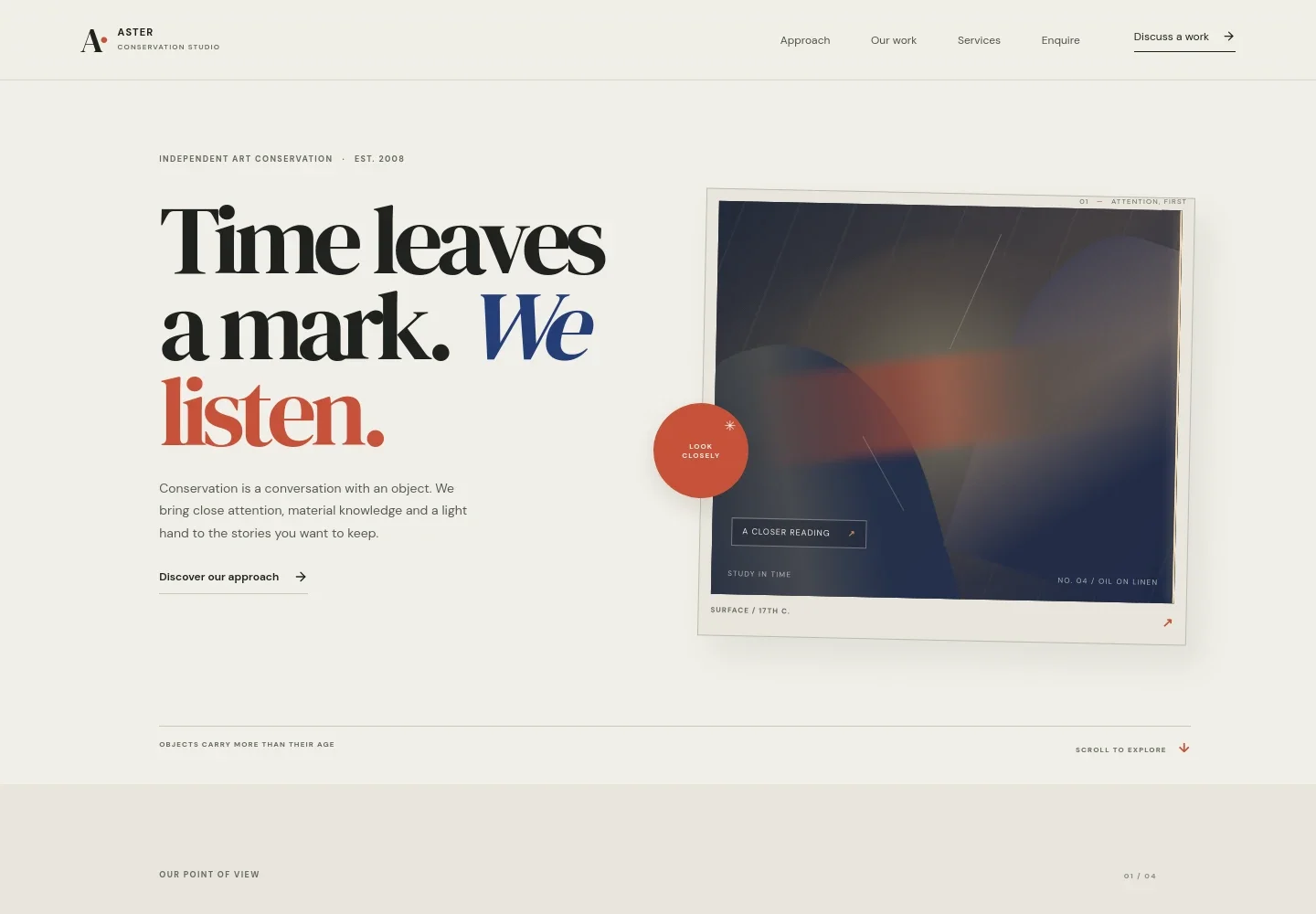
- Art conservation introduction
- An editorial-style opening pairs an artwork-inspired visual with a concise statement about close attention, material knowledge, and preserving an object's story.
- Conservation approach
- Explain why treatment begins with observation and understanding an object's materials, maker, and history, then outline the principles of preserving existing character and making decisions with the owner.
- Artwork detail interlude
- A close-up visual and short explanation illustrate the idea of making a work's layers legible without presenting conservation as making it new.
- Services
- Separate service rows describe care for paintings, works on paper, and objects and frames, helping visitors identify which type of work may fit their enquiry.
- Four-step process
- A clear sequence covers listening, examining and documenting condition, carrying out agreed care, and sharing guidance for handling, display, and future care.
- Enquiry invitation
- A closing section invites visitors to describe the work and what they have noticed, noting that photographs and any known history can help start the conversation.
- Footer navigation
- The footer repeats the studio wordmark and offers a return-to-top link, closing the page with a concise conservation message.
How to use this template
Open in Revamp
Click Use this template and sign in or create an account. You’ll start with your own copy of the design, ready to personalize.
Bring your content
Replace the sample text, photos, and logo with your own. Share your content, a document, or an existing website, and ask Revamp to adapt the template to your business.
Refine and publish
Ask Revamp to adjust the colors, layout, or sections, or edit directly on the page. Review desktop and mobile, then publish. You can keep making changes after launch.
Put your website to work
Make it easier to organize enquiries, consultations, and follow-up. Ask Revamp to add a suitable scheduling or client-management tool as your studio's needs develop.
-

Offer consultation scheduling
CalendlyLet prospective clients choose a time to discuss a work. Ask Revamp to add consultation booking with Calendly.
-

Keep enquiry follow-up organized
HubSpotTrack prospective clients and conversations in one place. Ask Revamp to connect HubSpot for contact and enquiry management.
Frequently asked questions
Is this template free?
Yes. This premium template is free to use when you select Use this template. The offer is for the template itself.
Can I use my own content?
Yes. Ask Revamp to personalize the page with your studio name, conservation approach, services, images, and contact details.
Do I need coding skills?
No. Ask Revamp to make content and design changes in plain language, without coding.
Can I change the design?
Yes. Ask Revamp to adjust the visual style, layout, colors, or typography to better suit your conservation practice.
Can I keep editing after publishing?
Yes. You can keep asking Revamp to update your content and design after launch as your services or studio details change.