About this template
Help visitors understand how Ethereum staking works, compare solo and liquid staking routes, and consider the responsibilities involved. The page explains validator participation, variable rewards, self-custody, and risks such as slashing, downtime, and liquidity constraints.
An orbital network illustration and a clear sequence of sections lead from the protocol’s point of view to the staking mechanism, operating principles, and a final learning prompt. The educational tone and plain risk language suit a staking provider or infrastructure project that wants to explain its approach without presenting rewards as guaranteed.
Who it’s for
Ethereum staking providers, validator operators, blockchain infrastructure teams, and crypto projects explaining proof-of-stake participation to prospective stakers.
What’s included
The design gives visitors a guided overview of an Ethereum staking concept, from the role of validators to key considerations before choosing a staking route.
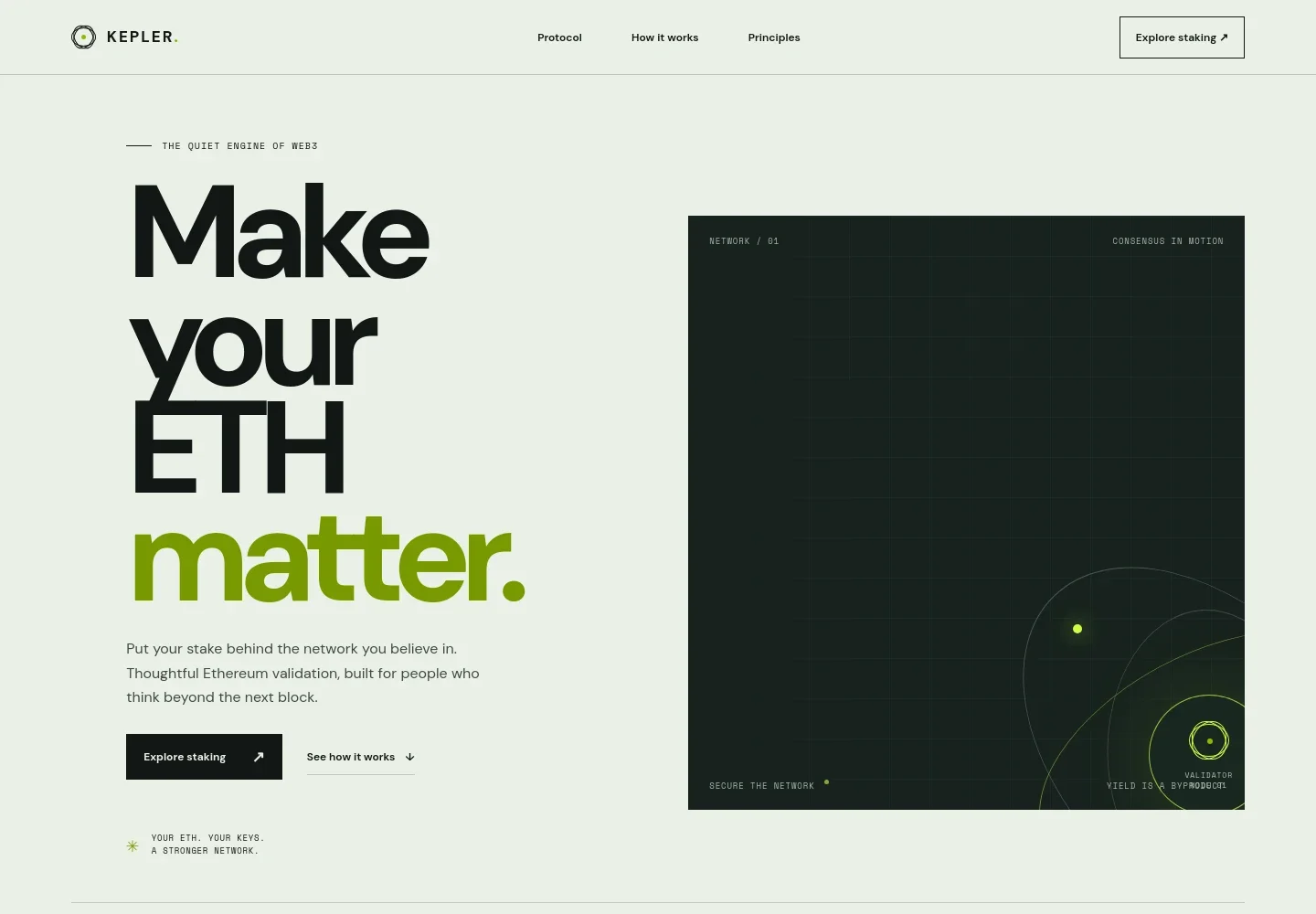
- Hero and network visualization
- Introduces the staking proposition with prominent calls to explore staking or see how it works, alongside an orbital illustration labeled with validator and consensus details.
- Protocol point of view
- Explains staking as an active contribution to an open and resilient Ethereum network, and states the template’s self-custody perspective.
- How staking works
- A three-step sequence covers choosing solo staking with 32 ETH or a supported liquid staking route, validator participation in consensus, and variable protocol rewards.
- Operating principles
- Three concise entries address retaining control of keys, open and inspectable tools, and risks including slashing, downtime, liquidity constraints, and changing rewards.
- Next-step call to action
- Encourages visitors to learn the fundamentals and compare options, with a link to Ethereum.org staking information and a note that the content is educational, not financial advice.
- Footer navigation
- Repeats the brand and offers links back to the protocol, principles, and staking information.
How to use this template
Open in Revamp
Click Use this template and sign in or create an account. You’ll start with your own copy of the design, ready to personalize.
Bring your content
Replace the sample text, photos, and logo with your own. Share your content, a document, or an existing website, and ask Revamp to adapt the template to your business.
Refine and publish
Ask Revamp to adjust the colors, layout, or sections, or edit directly on the page. Review desktop and mobile, then publish. You can keep making changes after launch.
Put your website to work
Help visitors move from learning about staking to tracking network activity or managing project inquiries. Ask Revamp to add relevant tools as part of a future site update.
-

Track Ethereum network activity
EtherscanGive technically minded visitors a route to public chain data. Ask Revamp to add an Ethereum network explorer link or data reference using Etherscan.
-

Organize institutional inquiries
HubSpotKeep prospective partner and customer conversations organized. Ask Revamp to add an inquiry form workflow with HubSpot.
-

Coordinate validator operations
Google CalendarMake operational events easier to coordinate across a team. Ask Revamp to add calendar scheduling with Google Calendar.
Frequently asked questions
Is this template free?
Yes. This premium template is free to use through Use this template. Free refers to the template itself.
Can I use my own content?
Yes. Ask Revamp to personalize the page with your project name, staking approach, explanations, links, and other content.
Do I need coding skills?
No coding skills are needed. Ask Revamp to make content and design changes in plain language.
Can I change the design?
Yes. Ask Revamp to adjust the visual style, layout, colors, typography, and sections to suit your brand and audience.
Can I keep editing after publishing?
Yes. You can keep asking Revamp to update the site after launch as your content and needs change.