AI Website Migration Statistics: 140 Legacy Websites (2026)
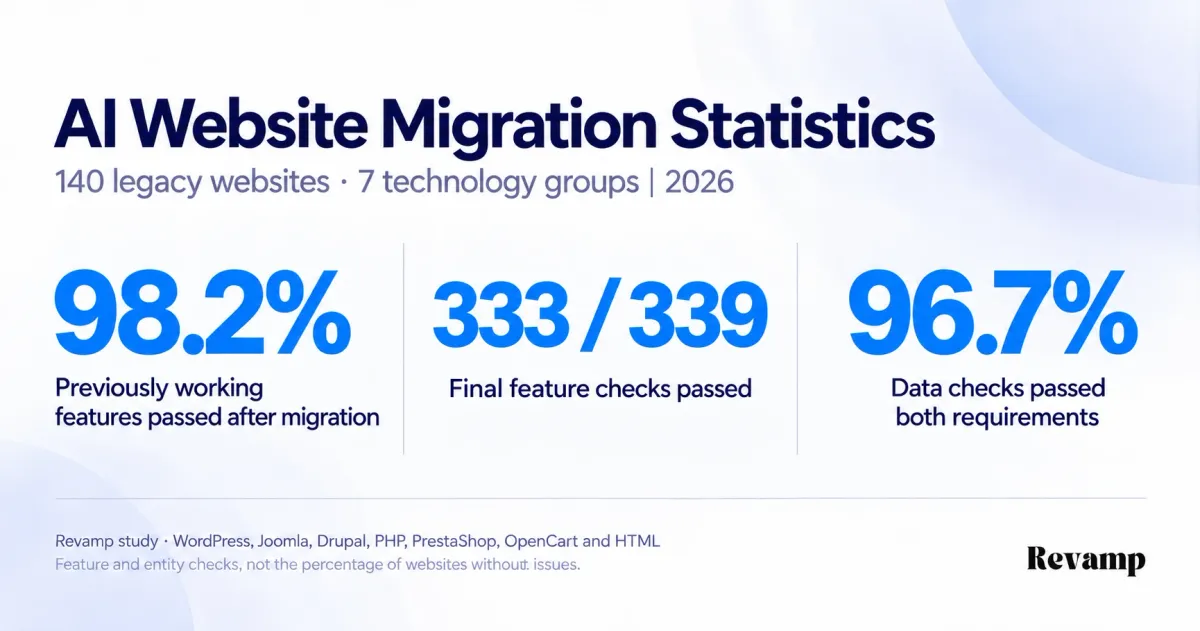
Revamp redesigned and migrated 140 legacy websites. Of the features that worked before, 98.2% still worked afterward.
Introduction
After redesigning and migrating legacy websites with Revamp, 98.2% of the features that worked before still worked afterward. In our study of 140 websites, that meant 333 of 339 features, including inquiry forms, bookings, online shopping and customer accounts.
The redesigned websites also received higher scores for design and mobile usability. The conclusion: AI website migration can modernize a legacy website’s design while keeping the features its customers depend on. The 98.2% figure measures features, not the percentage of websites migrated without issues.
These AI website migration statistics cover legacy websites built with WordPress, Joomla, Drupal, custom PHP, PrestaShop, OpenCart and hand-maintained HTML. Revamp was the platform used to redesign them, move their content and data, make corrections and edit them afterward. The findings below show what kept working, how the designs improved and how much working time was recorded. Methodology and sources explain how we calculated the results.
Key Takeaways
- 98.2% of previously working features passed after migration: 333 of 339 final checks, compared with 308 on the first assessment.
- 96.7% of data checks passed both requirements: 326 of 337 entity checks matched counts and important fields or relationships.
- Higher assessed design quality: the site-level mean rose from 3.67 to 6.15 out of seven, with the largest gain in mobile usability.
- 94.4% less recorded active working time in the matched comparison: means of 48.5 minutes with Revamp and 864.1 minutes manually, across 28 paired originals.
- 90.5% of subsequent editing tasks succeeded: 629 of 695 changes, including prices, new pages or products, design adjustments and publishing.
- Migration covered functional websites, not just presentation: the checks included customer accounts, commerce, bookings and portals alongside content and forms.
Explore the findings
- Functionality after migration
- Seven legacy technology groups
- Data reconciliation
- Design quality
- Matched migration effort
- Editing after migration
- Visitor tasks
- Mobile performance
- Assistance
- Practical implications
- Methodology and sources
1. Previously working features passed 98.2% of final migration checks
The research checked whether required features that worked on the original website still worked after migration. Across 339 such checks, 308 passed on the first assessment and 333 passed on the final assessment.
| Required feature | Previously working checks | Passed after migration | Final pass rate |
|---|---|---|---|
| Inquiry forms | 89 | 89 | 100.0% |
| Search and filtering | 49 | 49 | 100.0% |
| Customer accounts | 51 | 50 | 98.0% |
| Connected services | 48 | 47 | 97.9% |
| Portals | 30 | 29 | 96.7% |
| Bookings | 27 | 26 | 96.3% |
| Commerce | 45 | 43 | 95.6% |
| All previously working features | 339 | 333 | 98.2% |
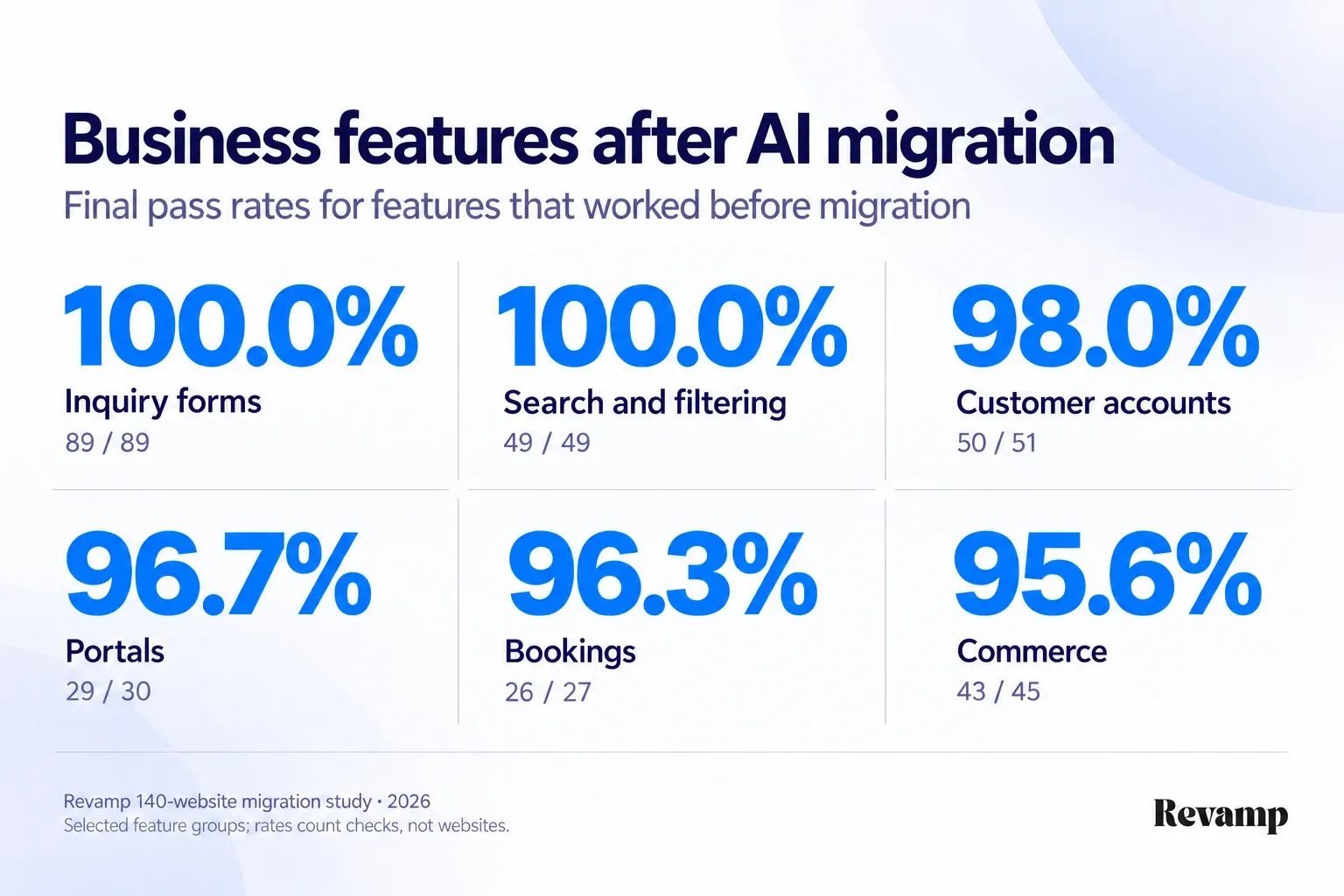
The difference between the two assessments was 25 additional passing checks, or 7.4 percentage points. Corrections belong in the migration process: the first result and the final result answer different questions.
The important distinction for a website owner is between a page that resembles the original and a website that still lets customers act. Inquiry forms, booking journeys and account access are operational requirements, not decorative elements. Six previously working features still failed their final checks; they remain in the denominator.
2. The study covered seven legacy technology groups
Each technology group contributed 20 websites. Functionality results below count previously working features, rather than websites or pages. A website can contribute several different checks.
| Original technology | Websites | Previously working checks | Final checks passed | Final pass rate |
|---|---|---|---|---|
| WordPress | 20 | 38 | 38 | 100.0% |
| Joomla | 20 | 37 | 37 | 100.0% |
| Drupal | 20 | 44 | 43 | 97.7% |
| Custom PHP | 20 | 54 | 54 | 100.0% |
| PrestaShop | 20 | 74 | 72 | 97.3% |
| OpenCart | 20 | 65 | 62 | 95.4% |
| Hand-maintained HTML | 20 | 27 | 27 | 100.0% |
The commerce groups contributed more functional checks than the hand-maintained HTML group. That makes a raw website count an incomplete description of migration complexity: a store’s products, accounts and checkout create different requirements from a small informational website.
The study concerns legacy implementations, not a claim that WordPress, PHP or HTML is inherently obsolete. Technology names identify the starting context; the intended outcome was a redesigned website that retained the owner’s required business functions.
3. Data passed both reconciliation checks in 96.7% of cases
Data migration was assessed through 337 entity checks covering content records, account data, products, variants and categories. Each check examined counts and important fields or relationships separately.
| Data-check outcome | Passed / checked | Pass rate |
|---|---|---|
| Expected and actual counts matched | 328 / 337 | 97.3% |
| Important fields and relationships passed | 334 / 337 | 99.1% |
| Both count and field/relationship checks passed | 326 / 337 | 96.7% |
These are entity-level checks, not percentages of individual customer or product records. Eleven checks did not pass both conditions.
Counting records is only one part of a migration. A product must also have the right price, variant and category; an account must retain the intended relationships. The combined result is therefore more useful than quoting the higher field-check percentage alone.
The input package matters too. Of the 140 websites, 94 supplied a source archive, 10 supplied exports, 11 supplied other authorized inputs and 25 used a public URL only. Private records are not available from a public homepage. Where they must carry forward, they need an authorized input alongside the redesign context.
4. Assessed design quality rose from 3.67 to 6.15 out of seven
The redesigns were scored across six dimensions. Averaging assessments within each website and then across websites produced an overall mean of 3.67 for original websites and 6.15 for redesigned websites, a 2.48-point difference.
| Design dimension, seven-point scale | Original website | Redesigned website |
|---|---|---|
| Visual hierarchy | 3.48 | 6.11 |
| Mobile usability | 3.00 | 6.11 |
| Navigation | 3.83 | 6.20 |
| Readability | 4.21 | 6.13 |
| Consistency | 3.74 | 6.23 |
| Ease of completing the main task | 3.76 | 6.09 |
| Overall site-level mean | 3.67 | 6.15 |
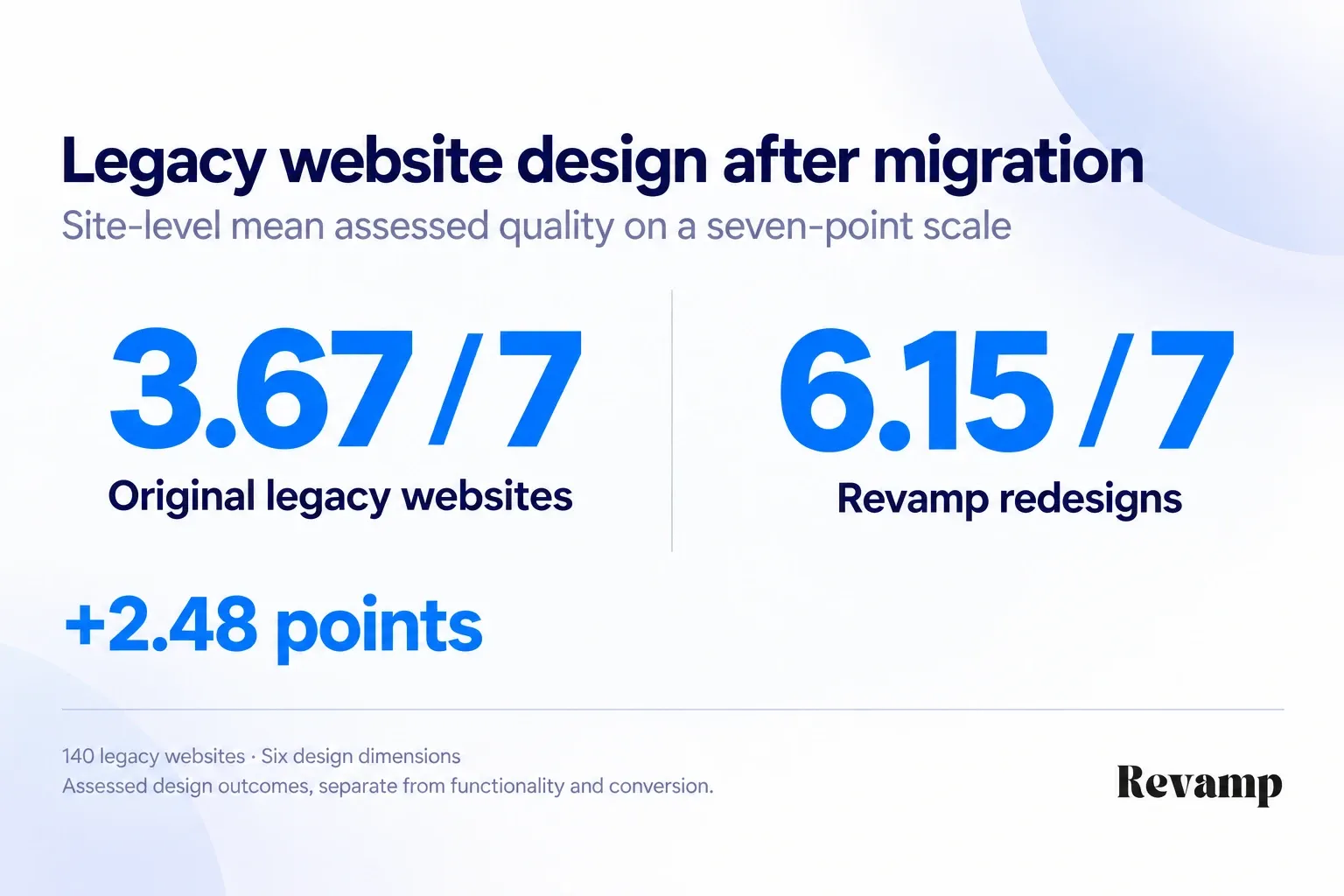
The largest recorded gain was mobile usability: 3.11 points. Better navigation, clearer hierarchy and readable mobile pages address why owners want to modernize an existing website in the first place.
These are assessed design outcomes, separate from feature checks and visitor conversions. The reviewer allocation and scoring calculation are described in the methodology.
5. Matched migrations used 94.4% less recorded active working time
The dataset contains 28 original websites with both a Revamp session and a manual migration session. Comparing those same originals gives mean recorded active times of 48.5 minutes with Revamp and 864.1 minutes manually.
| Matched migration measure | AI-assisted migration with Revamp | Manual migration |
|---|---|---|
| Matched originals | 28 | 28 |
| Mean recorded active minutes | 48.5 | 864.1 |
| Median recorded active minutes | 40.6 | 680.9 |
The 94.4% reduction uses unrounded means. Active time describes recorded human working effort, including setup, corrections and checks. It is not the elapsed time from starting a migration to a live launch.
For the entire 140-website Revamp sample, the median recorded active time was 44.3 minutes, and the mean was 51.0 minutes. Those whole-sample values are not substituted into the matched comparison.
For owners and agencies, this measurement addresses the work around the website: preparing inputs, refining the result and carrying out checks. It compares the recorded workflows in this study, not every manual migration provider or a guaranteed timetable for another project.
6. Operators successfully completed 90.5% of subsequent editing tasks
The research recorded 695 editing tasks on 139 websites. Five tasks were assigned per website, covering routine updates and more substantial changes. 629 tasks succeeded, with a median recorded effort of 7.0 minutes per attempt.
| Post-migration change | Successful / attempted | Success rate | Median minutes per attempt |
|---|---|---|---|
| Update a service price | 128 / 139 | 92.1% | 7.0 |
| Add a page or product | 125 / 139 | 89.9% | 12.8 |
| Change a section’s visual direction | 125 / 139 | 89.9% | 5.7 |
| Adjust a form or booking requirement | 126 / 139 | 90.6% | 9.0 |
| Publish an approved update | 125 / 139 | 89.9% | 3.8 |
| All editing tasks | 629 / 695 | 90.5% | 7.0 |
Help was recorded on 32 editing attempts, and 26 recorded a regression. The time figures include unsuccessful attempts; success is shown separately rather than implied by the median.
This is a distinct part of modernization. A redesigned website should leave its owner able to change a price, add an offer or adjust a customer journey afterward. Revamp’s workflow continues into those changes instead of treating the first redesign as a fixed deliverable.
7. Recorded visitor-task success was higher on redesigned websites
User-task records examined whether a visitor could complete a specific action on the original and redesigned presentations. Each task retained the same number of observations in both presentations.
| Visitor task | Observations per presentation | Successful on original | Successful on redesign |
|---|---|---|---|
| Find a service and its price | 140 | 52.1% | 95.0% |
| Submit an inquiry | 140 | 60.0% | 93.6% |
| Find a product variant | 31 | 35.5% | 87.1% |
| Complete a test booking | 49 | 63.3% | 93.9% |
Finding a service and its price showed a 42.9-percentage-point difference. Submitting an inquiry showed a 33.6-percentage-point difference.
These are observed task outcomes, not live customer conversion rates. They complement functional checks: a form can work technically while its layout or navigation makes it difficult to find and use. Modernization needs to address both.
8. Median mobile Largest Contentful Paint fell from 4.0 to 1.9 seconds
The performance dataset contains five repeated measurements per website and presentation, under a fixed emulated mobile condition. We took the median within each website, then the median across the 140 websites.
| Fixed-condition performance measure | Original website | Redesigned website |
|---|---|---|
| Websites measured | 140 | 140 |
| Runs per website | 5 | 5 |
| Median site-level performance score, out of 100 | 45.6 | 88.1 |
| Median site-level Largest Contentful Paint | 4.0 seconds | 1.9 seconds |
Largest Contentful Paint measures when a page’s main visible content appears. The recorded reduction accompanies improvements in mobile layout and task outcomes; it is not the sole measure of a successful redesign.
These are fixed-condition measurements, not real-user field Core Web Vitals or evidence of a ranking change.
9. Most migration sessions recorded no assistance
Across the 140 Revamp migration sessions, 80 recorded no help events and 60 recorded at least one. Sessions with assistance remain in the feature and effort results.
| Recorded assistance | Sessions | Share |
|---|---|---|
| No help events | 80 | 57.1% |
| At least one help event | 60 | 42.9% |
| Total | 140 | 100.0% |
The workflow measured here includes corrections and assistance where recorded. It should not be described as an entirely unattended migration process.
For a business owner, the goal is a modern, functioning website without having to become a developer. Both the automated path and help with exceptional migration requirements belong in evaluating that experience.
Practical implications
The findings point to three distinct jobs: improve the design, carry forward the business requirements and keep the result editable. A new homepage alone cannot establish all three.
- List what the business depends on. Include content, important URLs, forms, accounts, products, bookings and connected services before starting.
- Provide the right migration inputs. A public URL supplies visible context. Authorized exports, source files or access are needed when private content or records must move too.
- Check the actual customer actions. Submit the inquiry, exercise the account permissions and complete a test order or booking where relevant.
- Review URLs separately from design. Map old addresses to appropriate destinations and check content, indexing controls and tracking before launch.
- Make a real change afterward. Update a price, add a page or change the visual direction to verify the ongoing workflow.
Revamp’s AI website redesign platform brings the existing website into a continuing design and building workflow. Its scope includes pages and content alongside accounts, bookings, commerce, portals and connected services, with publishing and later changes in the same product. This study measures selected outcomes within that workflow, not universal compatibility with every legacy installation.
For launch planning and URL checks, see the website redesign and SEO migration guide.
Methodology and Sources
Study scope and inputs
Revamp conducted this internal legacy-website modernization study. Reanalysis in October 2026 uses anonymized migration-session, functionality, data, reviewer, task, editing and performance records. There are 140 websites, 20 per technology group, with one primary technology classification per website. The supplied session timestamps span May 26 to September 5, 2026; the documented study window is May 18 to September 25.
The recorded source versions cover WordPress 4/5, Joomla 2/3, Drupal 7/8/9, custom PHP 5/7, PrestaShop 1.6/1.7, OpenCart 1/2 and hand-maintained HTML. Findings describe these selected websites, not a representative sample of all websites or a measure of entire-platform obsolescence. The authorized input types are reported above; private data migration is not attributed to public-URL inspection alone.
Measurement and calculations
Functionality: preservation counts only the 339 features marked working before migration. Sixty-eight pre-existing failures and 24 unknown baseline results are excluded from that denominator. A final result must be recorded as passed; failed, unknown and not-applicable results are never converted into passes. First and final results are reported separately.
Data: the 337 entity checks assess counts and fields/relationships. The combined result requires both to pass on the same row. It does not measure the proportion of individual records transferred.
Effort: the paired comparison uses the 28 matching originals in the data, not the 14 described in the supplied methodology. The calculation is one minus the mean recorded active time with Revamp divided by the corresponding manual mean. All 28 pairs remain in the calculation. Session active-minute values are retained as recorded; attempt-level totals disagree with session totals in 159 records, and manual calendar durations disagree with elapsed-minute fields. Original session recordings were not supplied, so elapsed duration and first-draft timing are not reported.
Design: scores are averaged within each website and dimension before averaging websites. The records contain two reviewers for each original presentation and one for each redesign, rather than three per presentation. The unequal allocation prevents attributing the entire score difference to the redesign alone. No independent verification or fully blinded comparison is claimed.
Tasks, editing and performance: task success uses successful observations divided by observations for that task and presentation. The records do not identify individual task participants, so no participant-level causal comparison is made. Editing rates cover the 695 recorded tasks on 139 websites, not all attempted migrations. Performance uses the median of five runs per website, then the median across websites, under the recorded mobile-emulation condition. Tool versions and detailed collection settings are not established by the supplied artifacts.
Scope of the findings
The calculations preserve source observations and correct derived totals only. The supplied launch-ready flags conflict with critical URL and data checks, so no launch-ready success rate is reported. URL records repeat addresses across requirements with conflicting outcomes; they do not establish a unique-URL preservation rate. Search records lack dated launch/measurement windows and contain chronology conflicts, so no ranking or organic-traffic preservation claim is reported. Referenced source artifacts were not supplied for verification, and the stated preregistration could not be established from the available package.
For exploratory uncertainty, 4,000 resamples retain each website’s checks together within its technology group. The final functionality estimate of 98.2% has an interval of 96.9% to 99.4%. Resampling matched originals gives an interval of 93.4% to 95.2% for the 94.4% recorded effort difference. These intervals describe variation in the supplied records, not verification of the original observations or guarantees for future migrations.
Migration-check selection also follows the distinction between technical launch checks and post-launch monitoring in Semrush’s website migration checklist and Ahrefs’ website migration guide. These sources provide process guidance; they are not sources for Revamp’s study statistics.
Frequently Asked Questions
Can AI migrate an existing website’s functionality as well as its design?
In this study, 333 of 339 previously working features passed their final checks after migration with Revamp. The checks included forms, commerce, bookings, accounts, portals, search and connected services. The 98.2% result is a feature-check rate, not a guarantee that every website or legacy system will migrate completely.
How much working time did AI-assisted website migration save?
For 28 matched originals, mean recorded active time was 48.5 minutes with Revamp and 864.1 minutes manually, a 94.4% difference. These are recorded human-effort measurements, not verified elapsed delivery times. Preparation, scope and required corrections affect an individual migration.
Is a website URL enough to migrate private data?
No. A public URL provides visible content and design context. Private accounts, records and other restricted information require authorized inputs. The study distinguishes URL-only sessions from sessions supplied with exports, source archives or other authorized inputs.
Does redesigning and migrating a website guarantee preserved rankings?
No. Correct URL mapping, content checks and indexing controls are important, but search performance needs post-launch measurement. The available records do not establish a ranking-preservation result, and Revamp does not guarantee rankings.
Build what your business needs. Keep improving it.
- Start with your existing website or create something new from your idea
- Add pages, forms, bookings, payments and other business features by chatting
- Publish on your own domain and keep improving everything in one workspace
More Guides
AI vs. Manual Website Creation Statistics (2026)
92.5% less recorded working time for completed websites created with AI. Compare AI and manual website creation across 150 participants and 750 attempts.
Website Redesign Conversion Statistics: 22-Business Study (2026)
13.5% higher recorded conversion rates after redesign: website redesign conversion statistics from 496,781 visitors across 22 service businesses.
Website Trust Statistics: Design, Reviews & Contact (2026)
Website trust statistics from Revamp's internal analysis of 2,367 page ratings. Compare design, reviews and contact details, with methods and limitations.